
Lesson 11
In this lesson we will look at boat diving procedures.
Learning Objective
By the end of this topic, you should be able to answer these question:
Boat Diving Entries
Here are the general procedures you follow when entering the water from most dive boats:
1. After your predive safety check, confirm with your buddy and the divemaster/boat crew that you’re ready to enter the water.
2. Check that the entry area is clear of obstacles and other divers.
3. Partially inflate your BCD prior to entry.
4. Use your regulator during the entry. If you’re putting on your scuba unit after you enter, breathe through your snorkel.
5. Hold your mask firmly as you enter (just like you practiced during the PADI Open Water Diver course).
6. After entering, signal that you’re okay (assuming you are).
7. Have your buddy or the crew hand you accessories such as a camera, if any.
8. Move away from the boat/entry area so others can enter. Keep an eye on the boat because it may swing toward you
Small Boat Entries

Chances are you already know the most commonly used boat entries. From small boats, you may perform a sitting back roll (i.e. rolling backward into the water) or a controlled seated entry (easing yourself in from a seated position) off the gunwale. Both entries are appropriate with your scuba on or off.
Cabin Cruiser and Live-aboard Entries

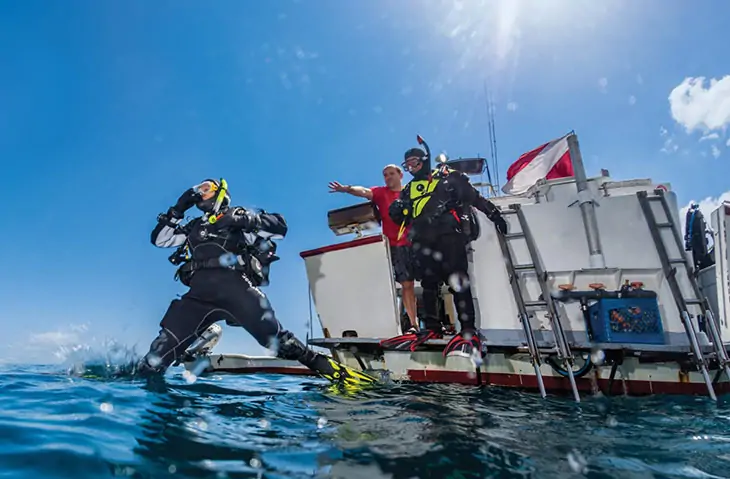
By far the most common entry from large charter boats is a giant stride. You may do this from the swim step or from the side of the boat. The giant stride is a particularly good choice for entries from a couple of metres/a few feet above the water.
Chances are you already know the most commonly used boat entries. From small boats, you may perform a sitting back roll (i.e. rolling backward into the water) or a controlled seated entry (easing yourself in from a seated position) off the gunwale. Both entries are appropriate with your scuba on or off.
Chances are you already know the most commonly used boat entries. From small boats, you may perform a sitting back roll (i.e. rolling backward into the water) or a controlled seated entry (easing yourself in from a seated position) off the gunwale. Both entries are appropriate with your scuba on or off.
Boat Diving Lines
One thing that separates boat diving from shore diving is that boat diving usually involves descending, ascending and even moving horizontally through the use of various lines. In areas with excellent visibility and little or no current, the only line from the boat may be the mooring/anchor line, which you’re already familiar with. Other areas, such as those with high current, diving may involve using multiple lines as part of your descent and ascents.
Gear Lines
Gear lines are lines you use to tie off equipment in the water, usually off the side but sometimes off the transom. They’re common in small boat diving (as previously described), but also used from all sized boats to suspend accessories like a camera for retrieval after you enter the water.
Tag Lines
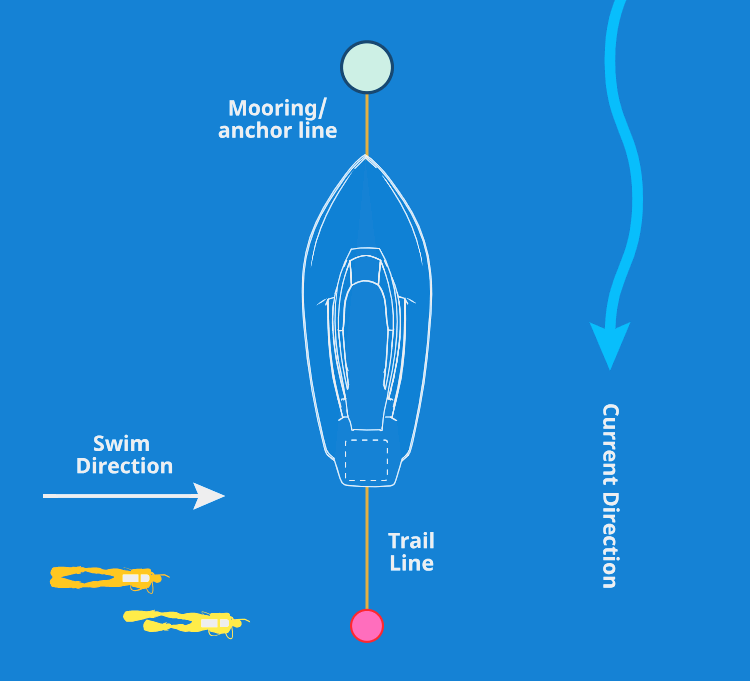
Tag lines (swim lines) may be used from any sized boat while anchored/moored in a current too strong to reasonably swim against at the surface. Tag lines run from the stern to the mooring/anchor line and allow you to pull yourself from the entry area to the mooring/ anchor line. At the stern, the tag line may connect to the transom, or it may continue past the boat and connect to the current line.

Ideally, a tag line attaches to the mooring/anchor line at about 5 metres/15 feet (accomplished by attaching the line and then letting out more mooring/anchor line). This starts your ascent as you pull yourself forward, which makes extra room at the safety stop depth for several divers coming up. However, it’s not always feasible to do this, in which case the tag line joins the mooring/anchor line at the surface.
Tag lines have differing names regionally. You may hear them called swim lines or (less politely) granny lines.
Current Lines
Current lines float behind the boat, extending from the stern and terminating in a buoy. This line provides a larger/closer target for divers who accidentally ascend behind the boat (down current), or alongside the boat to one side. In the latter case, the divers swim across the current to reach the current line, which is much easier (and more likely to succeed) than trying to reach the boat.

You also use the current line as a place to wait for your buddy after you enter, and to wait your turn to exit after you come up. When the current is strong enough to require current lines (and tag lines), it’s important to maintain line contact after entering, while descending, ascending and while waiting to exit. This is the only reliable way of being sure you don’t get swept away from the boat and have to be picked up. Current lines are also called trail lines or stern lines.
Trip Lines
You don’t see trip lines in most places, and they’re less common than they once were thanks to the increase in moorings. Trip lines attach to the front of an anchor and rise to the surface supported by a buoy. The crew uses it to “trip” or release the anchor because they can pull the anchor backwards with it, unhooking it.
Divers sometimes use trip lines for descent or ascents, but only when there’s little current. You don’t want to pull on a trip line because you can dislodge the anchor, particularly a small one.
Descent Lines
Descent lines are vertical weighted lines hanging from the boat, usually from the stern used for descent and ascent references. It usually doesn’t reach all the way to the bottom because the weight will do a lot of damage as the boat swings back and forth on its mooring/anchor. Instead, it usually stops several metres/feet above the bottom.

Descent lines are commonly used when the boat moors/anchors in a way that allows it to sit directly over the dive site, with the mooring/anchor some distance away. They’re also common in areas where you dive behind the boat, since the mooring/anchor line heads the wrong way.
Because they’re not secured at the bottom, they’re not very useful in anything but negligible current, because they seldom have enough weight for this purpose. A strong current can push enough to lift the divers, line, and weight almost to the surface. This is why the mooring/anchor line is a better place for safety stops in strong currents.
Gear and Swim Lines
Boat Diving Descents
The biggest difference between a shore diving descent and a boat diving descent is that when you’re shore diving, you commonly start in shallow water and follow the bottom into deeper water. Boat diving, you’re typically already in deeper water.
Mooring/Anchor Line Descent
Most boat diving descents are along the mooring/anchor line, especially in areas with currents. In stronger currents that you can’t reasonably swim against, the procedure is to enter the water next to the tag line (or by the current line in you have to wait for your buddy). Breathing from your regulator, you pull yourself to the mooring/anchor line, and then continue your descent hand-over-hand down it to the bottom, maintaining contact the entire time.

If you don’t keep a grip on it in a strong current, you’ll end up having to surface as quickly as you safely can and grab the current line. The current is usually much weaker at the bottom, allowing you to swim into it.
As you descend, be cautious because the anchor line will jerk up and down as the boat rises and falls on the swells. However, tension caused by the current and chain at the base of the mooring/anchor line help reduce this. Unless there’s almost no wind or current (which is rare), the mooring/anchor line isn’t vertical, but angled due to scope, with a curve at the bottom caused by the weight of the chain. The straightening and bending of this curve helps dampen wave action. When diving from an anchored boat, be alert for the boat needing to re-anchor. It doesn’t happen often, but if you suddenly feel the anchor line being hauled up, release it and swim clear.
Descent Line Descent

Make your way to the bottom along a stern-mounted descent line by following it as a visual or touch reference. Descent lines rise and fall with the boat, and they’re far more affected by wave motion than mooring/anchor lines because they don’t have the curve to dampen wave action..
Since you don’t use descent lines with much current, however, you don’t typically need to hang onto one that’s bouncing up and down.
Free Descent (no line)

In many situations, you descend directly to the bottom without using a line at all. This is particularly true when you can see the bottom from the surface and there’s little or no current. You can descend without a reference when you can’t see the bottom, but watch your gauges and your buddies so you don’t get disoriented in midwater. In any case, you and your buddy should keep track of each other, and be careful to watch your rate of descent.
Boat Diver Decents
General Procedures
Before descending, orient yourself to the boat’s direction and/or the shoreline based on natural navigation or your compass. Note your air pressure, the time and where your buddy is.
When possible, descend along a line as a reference to provide comfort and orientation. This is especially beneficial if you can’t see the bottom from the surface. If descending along an anchor line, use it only as a visual guide if there’s little or no current because pulling on it could dislodge it. While this is unlikely with a very large anchor, it is possible with a small boat anchor. This isn’t an issue with mooring lines, obviously, nor is a problem when the current is so strong that you must hang onto it as you descend.
When there’s current, there will be plenty of tension holding the anchor in place. As you descend, maintain buddy contact. Watch your depth, time and air pressure. If you’re descending by pulling yourself along a mooring line, watch where you put your hands so you don’t accidentally get any marine life stings. Some mooring lines have extensive marine growth so, as discussed earlier; you may want to wear gloves.
As you approach the bottom, control your buoyancy and avoid contact with anything fragile, such as reef organisms or shipwreck artifacts.
When you reach the bottom, you want to plan your dive so you end your dive at or near the boat. This avoids surface swims, which are more tiring and may present a hazard from boat traffic (use an inflatable signal tube if you must to be seen). When diving in strong current, ascending anywhere but along the mooring/anchor line risks ending up downstream and having to be picked up by the boat.
Most of the time, when you reach the bottom, you swim into the current, which is generally ahead of the boat (the boat may sit at an angle to the current if there’s a strong crosswind). By starting your dive into the current, it helps you rather than fights you on the way back.
In a few places, you dive behind the boat, between it and the shoreline. This is common, for example, where the bottom slopes steeply away from an island or reef, and there’s no current. One advantage of this is that you usually don’t have to worry as much about boat traffic (though you should still be vigilant).
Because boat diving usually puts you right on or very close to the best diving, you don’t need to go far, and it’s best not to. The farther you go, the harder it is to find your way back to the bottom.
Turn the dive and head back with plenty of air and no stop time left. If you reach it with more air or time left than you expected, you can usually finish the dive in the immediate area around the boat before heading up..
Drift Diving
Drift diving is a specialty beyond the scope of the PADI Boat Diver course. It involves diving in a strong current by riding with it rather than swimming against it, with the boat following you above.

Many of the same boat diving procedures and principles you’re learning in this course apply (so the PADI Boat Diver certification is an excellent one to have if you’ll be drift diving), but drift diving uses specialized techniques for entering, exiting, staying in a group, streamlining to avoid accidental damage to the environment, and surfacing safely around a maneuvering boat.
To learn more about drift diving, enroll in the PADI Advanced Open Water Diver course and complete the Drift Adventure Dive and/or the PADI Drift Diver course.
Ascents
Boat diving ascents are usually the reverse of the descents. That is, if you descended along a line, you usually ascend along the same line. If you needed to maintain line contact on the way down due to current, you usually need to maintain line contact on the way up.
Start your ascent by noting your bottom time, air pressure and other information.
As you ascend, remember S.A.F.E. concepts – Slowly Ascend From Every dive. This means no faster than 18 metres/60 feet per minute, or more commonly, an even slower rate as specified by your computer.
Unless you’re dealing with very low air or another problem, make a safety stop for at least three minutes at 5 metres/15 feet. If possible, ascend using a visual reference such as the mooring/anchor line or descent line. When diving in stronger current, the procedure is to ascend the mooring/anchor line, hanging on to avoid being carried away in the current. Often, you simply climb the line, hand-over-hand, facing into the current with your feet behind you like a flag going up a mast.

At 5 metres/15 feet (plus or minus if there are other divers in front of or behind you), simply stop climbing and hang on for your safety stop.
After the stop, continue up, transfer to the tag line and follow it to the stern. Whether you have a current or not, come up with your arm and hand extended upward, looking up and around. Rotate slowly for a clear view, and watch out for the boat bottom.
Try to break the surface near the boat, which should have a dive flag up. This reduces risk from other boat traffic.
If Caught Down Current
If you get disoriented and can’t locate the boat when diving in a current, ascend cautiously as far up current as you reasonably can. To reach the boat, don’t fight the current, but swim across it to reach either the boat or the current line.
If you miss, deploy your surface signaling device, establish buoyancy and signal the boat to pick you up. You may have to wait until they get everyone else aboard.
Boat Diver Assents
Boat Diving Exits
Most dive boats have one, or at most two ladders, so you often have to wait your turn near the exit area (usually the stern). If there’s a current, hang onto the current line. Establish buoyancy and, keep your mask on and your snorkel or regulator in your mouth while you wait. Stay well back from the exit area in case the diver ahead falls back in, or a cylinder drops out of a backpack.
If you have any accessories, you usually hand them up before starting your exit. Take your fins off only after making contact with the boat. When diving in currents, you may want to place your fins straps over your wrist (assuming they’re strap fins) rather than pass them up. That way, you can pull them on and swim for the current line if you lose your grip or fall back in and start to get carried away from the boat.
In any case, climb the boat ladder with your mask on and breathing from your regulator in case you fall back in. Stay adapted to the water until you’re completely clear of the water.
Some boats – especially large ones that stand well above the water – have a swim step or stern platform you climb onto to exit. Time your exit with the swells, using the water to help lift you up and onto the platform.
With small boats like inflatables or other vessels without a ladder, you’ll need to take your gear off in the water. You may also need to do this with some boats that have ladders that are too weak to support you with all your gear on – not unusual in tec diving.
In either situation, you’ll get out of your weights and scuba in the water and either and them up to someone on board, or tie them to a gear line to pull up after you get aboard.

To get into a small boat, you kick (so keep your fins on) upward and push with your arms, turning so you end up seated on the side (inflatables) or transom (hard-hull day boat).
Exiting The Water
Quiz
You need to be registered and logged in to take this quiz. Log in
{Module Title}
Copyright © Larry Wedgewood Scuba · All Rights Reserved