
Lesson 6
let's look at boating basics
Learning Objective
By the end of this topic, you should be able to answer these question:
The Rules of the Road
Even in flat calm conditions, operating a boat differs from driving a car in that the “road” extends in all directions and in most places, there are no lanes constraining where a vessel can go. Therefore, boats can approach you from any direction, and you can find yourself approaching one boat while another is crossing at your bow and another is crossing obliquely astern.
To avoid collisions and to allow everyone to progress smoothly and safely, boat operators follow the “rules of the road” that govern who makes way and who must yield when boats meet in open water. Just as streets have signs and warnings you obey as a motorist, inshore waterways often have beacons and markings that control traffic and direct you away from hazards.

Although different areas have differing nuances with respect to rules of the road, the principles you’ll learn as a PADI Boat Diver are the basic ones that apply internationally. Your instructor will brief you on local variations.
For example, navigation rules encompass lighting requirements for every description of watercraft. In most countries, power driven and sailing vessels less than 20 metres/66 feet are equipped with green lights on their starboard side and red lights on their port side. It’s important to note however, that the green/red lights on the starboard/port sides may be the other way around in some countries.
Keep in mind that this is a boat diving course, not a boating course, and this discussion isn’t intended to qualify you to operate a boat. Rather, you learn these basics so you can understand and recognize how and why the captain and crew operate their vessel the way they do, and how it relates to your safety.

Diving from boats is more interesting if you have a basic background in boating. It can also be quite practical information to know in the event you need to assist on board in an emergency, or if you plan to operate your own craft. If you’re interested in qualifying as a private or commercial boat captain, complete a locally sanctioned course in boat operations.
Vessel to Starboard Makes Way
The first principle you learn in boating is that when two vessels approach each other so their paths will cross, the vessel to the starboard makes way, i.e., making way and is called the stand on vessel. The vessel to port is burdened and must maneuver or slow to allow the other vessel to continue on course. The vessel with way should maintain its course and speed so the burdened vessel can avoid it more easily.

You can think of the area from bow amidships down the entire starboard side as the “danger zone” in which any approaching vessel makes way. The captain or pilot watches around the entire vessel, but watches this area especially because boats in this zone are the ones that legally require maneuvering to avoid.
If you watch closely, you’ll often notice that the captain does not maneuver or change speed as another boat crosses the bow from the starboard side, and that vessel passes with ample safe space.
How does the captain know that they weren’t on a close course or a collision course?
You can determine a collision course by watching the relative position of an approaching vessel – if it doesn’t change, you’re on a collision course. So if you see, for example, a boat approaching and it remains exactly off the same point on the starboard bow, and it’s still there as you get closer, your vessel needs to alter speed or direction.

If, on the other hand, its relative position shifts so that it’s closer to the bow or farther from the bow, then you know it will pass ahead or astern, respectively. If the relative position is changing but very slowly (and the vessel is close), then there’s still some risk of a collision or passing too close for safety, and your vessel must give way.
By the way, this relative position principle works with any two moving vehicles, including airplanes and motor vehicles.
Exceptions to the Rule
To keep things interesting, there are some exceptions to which vessel is burdened. A sailboat under sail makes way over a boat under power, even if the sailboat approaches from port. A sailboat under power is treated the same as any power boat, and when two sailboats under sail approach each other, the one to starboard makes way.

Another exception is “might makes right,” which is to say that relatively small, maneuverable vessels accommodate very large, cumbersome vessels regardless of the usual rules. Even a large charter boat is considered small and maneuverable compared to an oil tanker, and would almost always accommodate the tanker if they approached each other near a harbor entrance, for example.
While this is an informal rule in most areas, it’s widely recognized and applied because the smaller vessel can stay clear of the larger one much more easily than vice versa, and because the reality is a large freighter could crush and sink a hard-hull day boat without the freighter’s captain or crew knowing it happened.
Finally, vessels that cannot maneuver makes way, irrespective of size. Commercial fishing boats putting down or taking up nets are one example. A dive boat flying the Alpha (blue and white) dive flag while accompanying drift divers also makes way, legally speaking.
Head on Approaches
There are rules for when vessels approach head on so that two vessels don’t hit because they’re trying to evade each other. As a matter of historical interest, it was confusion over following these rules that led to the Stockholm striking the Andrea Doria in 1956 (there’s still dispute over who was at fault), despite the fact that both vessels were alone in a huge ocean and trying to miss each other.
The rule, generally, is that vessels pass port to port, or “keep right and you’ll be right.” This is a general rule, however, in that two vessels may pass starboard to starboard when, for example, they’re adequately separated and it’s obvious that’s what they’re going to do to both captains.

Despite these rules, circumstances and conditions sometimes make it hard for the captains of their respective vessels to understand what the other intends to do. When this happens, captains communicate. They can do this by radio, gestures or a horn blast, but more often it’s making a clear, early deliberate maneuver in a safe direction that reveals a clear intention to the other captain. In these situations, it’s important to avoid subtle, hard to detect course changes because the other vessel may not recognize and adjust accordingly.
Overtaking
When two vessels are headed the same way and the one astern wishes to pass the one ahead, it signals with its horn (two long and one short blast) and passes along the starboard after the forward vessel replies with a single blast.
Inland rules differ slightly here with giving one short blast of the horn if passing to starboard, or two short blasts if passing to port and the vessel to be passed replies in same to acknowledge a starboard or a port passing.
Duty to Avoid Collision
The last rule of the road is a “catch all” that keeps everyone responsible and reasonable.

All vessels have a duty to avoid collisions, regardless of circumstances, including giving way if necessary when the other vessel is supposed to be burdened.
This is especially true where there are many recreational boaters, many of whom due to inexperience are more likely to confuse or fail to recognize who makes way. Therefore, after a collision, having way, by itself, is not an adequate defense.
Common Navigational Aids
Just as you have signs on the road that direct you when you operate a motor vehicle, there are common navigational aids that direct your path and help you avoid hazards when boating. These take several forms, depending upon the use and where they’re placed.
Buoys
Buoys (sea marks) are any of many floating devices used to aid piloting by marking a channel, hazard or administrative area (such as mooring zone, swimming area, etc.).

Buoys are typically color-coded and often shape-coded to tell you what they mean, and many have their meaning stenciled onto them as well. Among other uses, buoys are used as channel markers (along with pilings jutting up from the sea floor), with red and green used to mark the channel.
In most countries, the usual convention is to have green on the starboard side when outbound and red on the starboard side when inbound (think “red-right-return”).
In some countries however, it’s exactly the other way around. Returning from sea, the green markers are on your right, or starboard, and the red are on your left, your port side, and between is the channel. In most areas, the green markers, are cylindrical buoys or rectangular signs (on pilings), and the red are on pointed buoys or triangular signs. These are sometimes called cans and nuns or conical respectively, due to their shapes.
Day Beacons
Day beacons are any of a wide variety of unlighted nautical sea marks. Typically, they’re used to supplement lighted buoys in marking channels, but they may also mark smaller navigable routes in their entirety.
Light Beacons
Light beacons are lighted nautical sea marks used for navigating after dark. While you find them commonly in well-populated, frequently used waterways, many don’t have lit beacons of any kind.
Fog Signals
Fog signals are devices used in fog to mark a hazard or a key navigation point, such as a shallow reef or a harbor entrance. Fog signals produce an audible warning and sometimes a visual one, too.
Lightships
Lightships are vessels stationed offshore to warn other vessels of hazards to navigation. Besides lights, they are typically equipped with fog signals and radio beacons.
Dive Flags
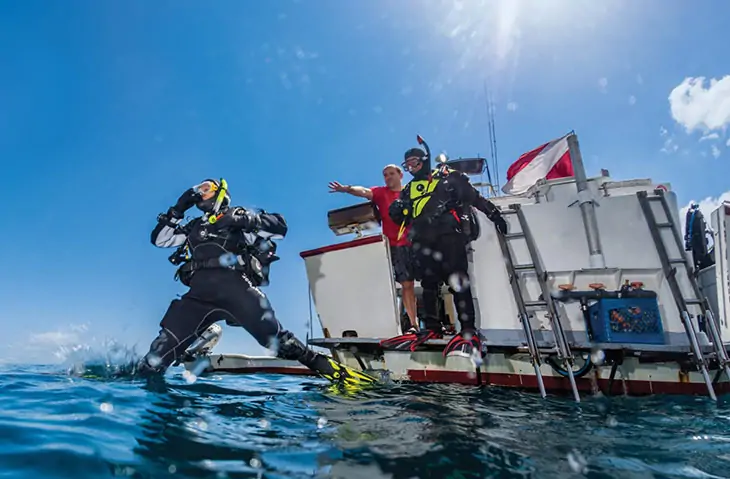
You’re probably already familiar with the Alpha (blue and white) and diver-down (red with white stripe) flags. Depending upon where you are, your boat may be required to fly either or both flags when divers are in the water.


The Alpha flag is an international boating signal that means “I have divers in the water and am restricted in my ability to maneuver.”
The red diver down flag means “I have divers in the water – keep clear a safe distance.”
The distance is commonly dictated by regulations, typically mandating that other vessels stay 30 to 90 metres/100 to 300 feet away. The flag flown and the distance to stay away are dictated by local regulations.
Different Rules for Different Places when Inbound/Returning
Maritime marks used to indicate the edge of a channel are distinguished by their color, being red or green, and shape. Two different schemes are in use worldwide, differing in their use of color. The International Association of Marine Aids to Navigation and Lighthouse Authorities (IALA) defines them as Region A and Region B.
Region A – Used by Europe, Australia, New Zealand, parts of Africa and most of Asia other than the Philippines, Japan and Korea. Port marks are red and may have a red light. Starboard marks are green and may have a green light.
Region B – Used by North America, Central America and South America, the Philippines, Japan, and Korea. Port marks are green and may have a green light. Starboard marks are red and may have a red light.
In both regions, Port marks are square or have a flat top. Starboard marks are conical (or present a triangular shape) or have a pointed top.
Docking and Undocking (Leaving the Dock)
As you may recall from the PADI Open Water Diver course and the PADI Rescue Diver course, the majority of dive accidents occur at the surface. This is the area where you transition from above water to underwater or vice versa, and the transition has some potential problems when divers don’t follow proper procedures and adhere to good habits.
Docking and undocking are similar transitions in boating, going from a freely operating vessel to one tied in place or vice versa. And also similarly, you avoid problems by following procedures that take you smoothly through this transition.
On a charter dive boat, responsibility for docking and undocking lies with the crew.
And there’s certainly nothing wrong with offering to help if you know what you’re doing, you make the offer without distracting the crew from what they’re doing, and you don’t do anything unless they accept.

As a passenger, during docking/undocking, stay clear of dock lines and the side of the boat that is or will be tied up. The crew may ask all passengers to sit down. Doing this increases visibility for them and minimizes confusion caused by you and others moving about. It also has the benefit of reducing your risk of falling if the boat bumps the dock harder than expected. When you sit, try to do so away from the exhaust because the engine will likely be running for several minutes before departure and after arrival.
Undocking and Docking Crew Procedures
Undocking – wind or current pushing the boat away from the dock
1. Cast off lines and pull in fenders as the wind blows the boat away from the dock.
2. When clear and safely away from the dock and other boats, the captain shifts the engines to forward and departs at the ideal speed.
Undocking – wind or current is pushing the boat toward the dock
1. Cast off all lines except an after bow spring line (line from bow to cleat on dock amidships). This keeps the boat from moving forward and allows the stern to pivot away from the dock.
2. The crew puts a fender forward to cushion the bow of the boat against the dock.
3. The captain turns the motor or rudder to the direction necessary to push the stern away from the dock and shifts the engine forward at idle speed.
4. The stern swings away from the dock. When clear of obstacles and traffic, the crew casts off the spring line. The boat backs away from the dock and, when safe, shifts into forward and idle (let the engine revolve slowly with throttle nearly closed) away from the dock.
Docking procedure – wind blowing toward the dock
1. Before approaching the dock, the crew ensures one end of the docking line is secured onboard and that fenders are ready. The captain reduces speed.
2. The captain brings the boat parallel to the dock at about .6 metres/2 feet off. The wind blows the boat in.
Docking procedure – wind blowing away from the dock (outboard/inboard outboard engines)
1. Before approaching the dock, the crew ensures one end of the docking line is secured onboard and that fenders are ready.
2. The captain approaches the dock at a 20- to 30-degree angle. The crew passes a bow line ashore and secures it.
3. The captain turns so the propeller is towards the dock and reverses the engine. This brings the stern into the dock.
4. The crew can secure the boat with the stern line.
Docking procedure – wind blowing away from the dock (inboard engines)
1. Before approaching the dock, the crew ensures one end of the docking line is secured onboard and that fenders are ready.
2. The captain approaches the dock at a 20- to 30- degree angle. The crew passes a bow line ashore and secures it.
3. The crew attaches an after-bow spring to keep the boat from moving forward.
4. With the engine idling forward, the captain turns the wheel away from the dock. Since the boat cannot move forward, and the rudder pushes the stern toward the dock while the crew secures the other lines.
There’s a difference between a boat being tied up and a boat being secured. Often the initial tie simply keeps the boat from drifting away from the dock, and it will take additional ties and adjustments before the vessel’s secure enough for people to climb off and on.
It’s a common misperception that because a boat is moving slowly, it will be easy to stop. This isn’t true, because the size of the boat is part of the equation.
Although the vessel may not be moving that fast, the momentum due to size can cause significant injuries, especially if your limbs get trapped between the vessel and the dock.
A large boat that is moving very slowly can still crush and/or break your arm or leg if it gets pinned between the boat and the dock. Leave it to the captain to use the engine to stop the boat.
If you’re assisting the crew (or helping out on a private boat) undock, keep in mind that the dock lines may stay with the boat, or they may stay on the dock. Follow the crew’s directions regarding which end of the line to release – the end on the boat or the end on the dock.
When assisting with tie up, you always tie the line – whether on the boat or the dock – to a cleat. Never tie to the boat’s rail or route the line so there’s stress against anything other than the cleat, and never tie to anything but a cleat unless directed to do so by the crew.
QUIZ
You need to be registered and logged in to take this quiz. Log in
{Module Title}
Copyright © Larry Wedgewood Scuba · All Rights Reserved