
Lesson 10
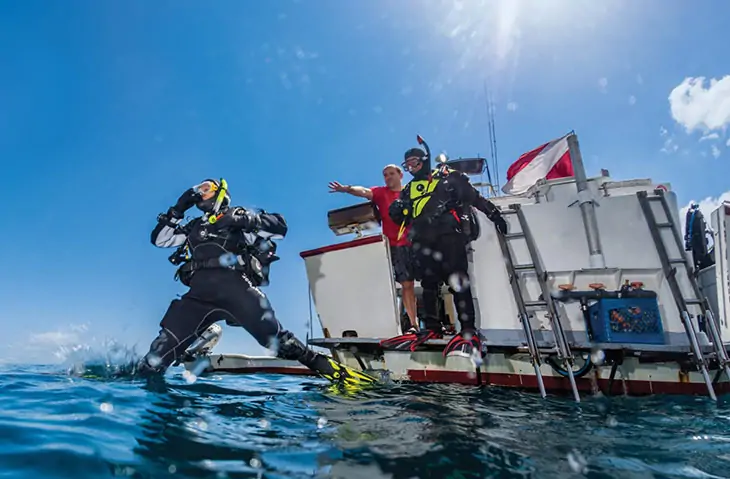
Charter boat diving
Learning Objective
By the end of this topic, you should be able to answer these question:
Learn the Procedures
As you visit different dive destinations around the world, you’ll find that each region’s dive boats have somewhat differing protocols to follow when you come aboard. Since these protocols vary depending upon the type of boat, regional logistics, number of passengers and other differences between vessels, it is important that you always listen carefully to the briefing prior to diving. Nonetheless, the procedures you generally follow are outlined below.
Arrival and Boarding
As a rule of thumb, plan to arrive at the dive boat at least a half an hour prior to departure – or earlier if so requested by the crew. Make sure the crew’s ready for you to board (they may still be preparing and need you to stay on the dock), and stow your gear according to their directions. This is important because there may be specific areas that need to be kept clear for safety or access, and certain areas may not be appropriate for lead or cylinders.
Generally, you’ll stow personal items that you want to keep dry somewhere forward under cover. It’s best to expect anything left on deck to get wet. The smaller the boat and the rougher the conditions, the more likely this is true. For small boats like inflatables that may not have reliably dry areas, a dry bag is a good option.

Most charter boats will have you fill in your name in on a roster, plus complete paperwork such as liability releases/assumption of risk. It’s important to complete these before the boat departs.
On some boats, you use any filled cylinder available, on some you bring your own, and on yet others, you’ll put your name on a specific cylinder. Follow the crew’s direction, and again, be sure the cylinder is well secured in its rack, with the retaining bungee (if there is one) in place.
Predeparture and Predive Briefings
The captain, crew or divemaster will usually conduct a predeparture briefing, which may be separate from or include the predive briefing (typically depending upon how long the ride is to the site). Predeparture briefings and predive briefings are for your safety as well as enjoyment, so stop what you’re doing and pay attention (besides, this is just common courtesy).
The pre-departure briefing covers where to find safety equipment (PFDs, first aid, etc.) and a roll call from the roster to be sure it lists everyone aboard. Since the crew uses the roster to account for everyone, never answer for someone else, even if you believe that person is aboard. If you don’t hear your name called, be sure to alert the divemaster/crew.
The pre-departure and/or predive briefing provides a boat dive area orientation so you have a problem-free boat dive. It typically includes the following four topics, among others:
1 – Facility/Boat Orientation
This covers things like where the head and showers are, food concessions or coolers, where to stow things you want to stay dry or safe, where to find safety equipment and other information that makes your stay on the boat more enjoyable. You may also learn about areas that are off limits (such as an engine compartment) or restricted (such as staying out of the bunk area while wearing a wet exposure suit). If it’s not obvious, the crew will recommend where to gear up.
2 – General Characteristics
If the information’s available (it isn’t always), the divemaster will brief you on the bottom type and topography to expect, the depth range, current speed and direction (if present), areas you may want to avoid and areas you may specifically want to be sure you see (where the good stuff is).

The briefing usually covers interesting or helpful facts about the site, such as how it got its name or a summary of a wreck’s history. It may cover sensitive natural and/ or cultural features of the site (such as fragile corals or exposed shipwreck parts) as well as environmental regulations and other conservation practices applicable to the site.
As necessary, the divemaster may suggest a dive plan and techniques and locations for entering and exiting the water. The divemaster may also suggest minimum experience/training for the dive, for options within the dive.
3 – Buddy Team Considerations
Especially on open charters (anyone can sign on for a dive), the crew usually checks to be sure everyone has a buddy. If someone doesn’t have a buddy, the divemaster may help unbuddied divers connect so they can find someone to dive with. With a closed boat (entire boat booked by a dive center or other group), buddy teams may be expected to be handled within the group.

It’s typical to recommend that those inexperienced with the area try to dive with someone who is. The briefing may also review buddy team procedures, especially if there are any protocols unique to the area.
4 – Communication, Emergency Procedures and General Safety Rules
Although much of this typically reviews what you already know as a certified diver, it’s important to listen because it will also cover the specifics the crew uses with respect to them.
During the briefing, the crew may review hand signals, especially if the divemaster will be leading a tour. It’s typical to be reminded to always signal “okay” when you surface, and you may hear about recall procedures, the role of supervisory personnel, what to do in an emergency, out-of-air procedures and when to exit. An experienced divemaster won’t reteach what you already know, but rather apply your basic diving knowledge to the specific circumstances of the dive.
After the briefing, you and your buddy plan your dive based upon the information in the briefing, as well as your own training, personal limits and experience you have with the local environment. Be sure to check your dive computer and the RDP no stop limits.
Suiting Up and Gearing Up
There’s significant variation in how and when you suit up depending upon the boat size, the climate and the time from dock to dive. Similarly, how and when you get into your kit will depend upon the boat and the conditions.
Inflatables and Small Hard-hull Day Boats
With deck space at a premium in small vessels, it’s typical to assemble and check your scuba kit before you leave the dock. Depending upon how much space you have, the weather, the surface conditions, and how long before you reach the dive site, you may put on your exposure suit entirely, partly, or not at all.
In cool climates, you may dress into your dry suit for the entire ride (even a moderately long one) so you’re comfortable even with wind and spray. In hot, tropical climates, if you have a long boat ride, you may wait until you’re on site so you don’t overheat.
A common in-between solution is to put on your wetsuit, but leave it peeled down to your waist.
On site, with small boats, there are two options for gearing up.

One is to inflate the BCDs and put your scuba units over the side on a line. This frees the deck for getting into your exposure suit, etc. Then, enter the water and put your kit on at the surface. Alternatively, you can pull them back aboard, gear up and back roll in.
The other option (especially if you’re already in your suit) is for buddy’s to help each other into their kits and enter using the sitting back-roll. This is a particularly good strategy in rough conditions. Either way, be sure to conduct a predive safety check.
Cabin Cruisers and Live-aboards
Although you have more space on these larger boats, you still have to think about how you use that space. As discussed earlier, you’ll normally set up your gear and leave it secured in the cylinder rack. On day trips you commonly do this before you leave the dock, and on overnight trips you typically set up for the day, but take everything apart, rinse and stow it overnight.
With the space available, you usually only get into your exposure suit before departure if the ride is going to be very short, or if you’re diving in seas so rough that it will be difficult to do so offshore (this is for well seasoned divers, obviously). In warm climates and under sunny skies, you’ll typically get into your exposure suit on deck, leaving your dry clothes forward or below decks.
In cooler climates, you may dress into your dry suit undergarment in the salon or below decks, and put on the dry suit in a relatively sheltered area above deck.
Gearing up depends partly on the vessel’s configuration. On boats with seats in front of the cylinder racks, first put on your weight belt if you’re wearing one. Then, release the cylinder bungee (if present), and slide into the BCD so you end up sitting with the cylinder in the rack. Buckle your BCD, and then secure your hoses and gauges. You’ll be able to get completely ready to go, including most of your predive safety check, while remaining seated – especially advantageous when the boat’s pitching on the waves. When it’s time to dive, pull on your mask (you should have defogged it earlier, while prepping your scuba unit), but not your fins.

Stand up carefully (if you forgot to release the bungee, this is when you find out and sheepishly ask someone to unhook it), helping and being helped by your buddy. Walk back to the entry area, complete your predive check (whatever you couldn’t do while seated), and partially inflate your BCD. Put your fins on last, just before you enter the water, with your buddy helping steady you. Avoid walking on deck with fins on, because you can easily lose your balance and fall.
In some areas, large dive boats don’t have seats in front of the cylinder racks. If this is the case, you and your buddy will lift and hold each other’s scuba units so you kit up and perform your predive safety checks standing.
You may be able to get into your scuba unit independently by balancing it on a sturdy rail (but don’t do this in rough conditions because it may go over the side), but don’t swing it over your head old school style.
You may bonk someone in the head or lose your balance and fall because the boat rolled with your kit over your head.
Note: Virtually all dive boats reasonably accommodate individual needs and will help you depart from the standard methods of gearing up, entering, exiting, etc. If you have a physical challenge or some other reason to do things differently, be sure to ask the crew and your buddy.
Non charter, Private Boats
The predive procedures when diving from private boats (which, in fact, most inflatables and hard-hull day boats are) are the same as from charter boats, but you have some additional considerations.
The first is that you never leave a vessel moored or anchored unattended. There should always be someone aboard who can operate the boat in case it breaks free, the anchor drags or the divers need help. This isn’t always convenient, such as you have three divers in a small boat, but you can make it work: Diver A dives with Diver B while Diver C waits in the boat. For the second dive, A and C dive while B boat sits. Finally, A tends the boat while B and C dive together.

It’s also important to be flying an appropriate dive flag in accordance with the regulations for the area (as discussed earlier).
Although as a diver you want to be sure to fly a dive flag for the safety benefits, it is the captain’s legal responsibility.
Finally, when planning to dive from a private boat, consider enrolling in your local boating class and remember to pay special attention to the basic guidelines to boating safety outlined in this course.
Predive Roll Calls
You can expect the divemaster or crew to call roll before and after each dive from a charter dive boat. Particularly with a larger boat with many divers, this will be a formal gathering with the divemaster calling out names and listening for responses. If there are only a handful of passengers aboard, the divemaster may silently check off each name of every diver leaving and returning to the boat, but either way, this is an important standard safety procedure.
Confusion about this has caused divers to accidentally get left at dive sites. It is your responsibility to take pre and post-dive roll calls seriously, and to be sure that you and only you answer when your name is called. This procedure is for your safety. (If it ever seems inconvenient – like you need to go to the head – just imagine how inconvenient it would be to surface in the middle of the ocean with the boat nowhere in sight.)
quiz
You need to be registered and logged in to take this quiz. Log in
{Module Title}
Copyright © Larry Wedgewood Scuba · All Rights Reserved