
Lesson 5

let's look at the types of boats you can dive from
Learning Objective
By the end of this topic, you should be able to answer these question:
Dive Boats
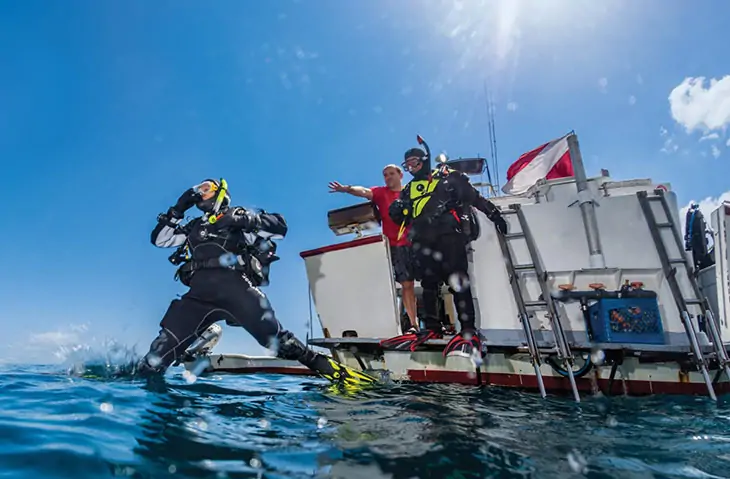
If it floats and carries a person, it’s probably been at least tried as a dive platform. Today, boat diving takes place from vessels ranging from small ships to single person sit-on-top ocean kayaks. Small runabouts, motorsailers, sailboats, pontoon boats, and luxury yachts have all been used to support diving. Diving from the largest live-aboard dive boats may involve diving from the live-aboard itself and from its smaller support boats, depending upon the dive site and where the vessel moors.
Features
Whether a racing yacht or run-of-the-mill rowboat, there are three features that you expect from a good dive vessel:
1. Ample deck space
2. Stability
3. Power
What you mean by each of these depends partly on the situation, so that a boat can be an excellent dive vessel in one environment, and a very poor one in another.
1 – Ample Deck Space
Diving takes up a lot of room, so you want ample space for your gear, setting it up and getting into it. Sometimes, a smaller vessel with more deck space is a far better choice for diving than an equal or larger boat that lacks deck space due to features or luxuries. A good example would be two medium-small inflatable boats (about 5 metres/15 feet long), one with a center wheel console and one with a basic tiller outboard. The one with the basic outboard may not be as comfortable to operate, but will have much more deck space.

What you mean by “ample” also depends upon how diving takes place. In some areas, you set up all your gear, load it aboard and put on your exposure suit before you leave the dock for a short ride to the dive site. After the dive, your gear stays together and you stay suited up until you return.
In this case, you don’t need as much space as if you’re going to be out on the boat all day and must set everything up and gear up on the water.
2 – Stability
Dive boats must be as stable as reasonably possible so you can maintain your balance standing (on larger boats) with gear on, to minimize the potential for equipment to roll about, and for passenger comfort. Again, stability is a relative term. Even in rough conditions, even a relatively stable boat isn’t that stable. Likewise, a boat with only marginal stability characteristics may be more than adequate for the smooth water you find on lakes or in protected bays and waterways.

In designing a boat, there’s a trade between stability and seaworthiness. A vessel that rolls easily is said to be tender, and all else being equal, a tender vessel is less likely to capsize in large waves than is a more stable vessel. However, a vessel can be very tender due to poor design or improper loading, in which case it can be both tender and unstable
Fortunately, design issues aren’t common in modern vessels and loads shouldn’t be issues when the crew observes load requirements (found on the boat capacity plate, usually placed near the wheel).
From a practical sense, most charter dive boats and most popular private boats are relatively stable and have excellent seaworthiness. When conditions are beyond what these vessels can safely handle, you’re not likely to be out diving anyway.
3 – Power
Dive gear adds a good bit of weight compared to hauling the same number of passengers without it, so a dive boat needs to have ample power to move the weight in the most demanding conditions (waves, current, wind) you’re reasonably likely to face. The boat also needs adequate power to reach and maintain a reasonable speed should it be necessary to transport an injured diver.

Again, this is relative. If you’re going a short distance over smooth water, a very small engine may be more than adequate. In some places, it’s common for seven or eight people to dive from 4 metre/12 foot boats propelled by 10 to 15 horsepower engines.

On the other hand, for example, the large inflatable dive boats used in the North Atlantic and Mediterranean have comparatively more power for their weight so they move reliably and quickly through rough seas and against wind and current while fully loaded.
These vessels commonly have twin engines with more than 100 horsepower combined.
Dive Boat Categories
Because there are many different types of vessels suited to many different aquatic environments, you could create perhaps dozens of descriptions to categorize them. For the purposes of this course, though, we can generalize more and use four basic categories based on broad characteristics they share.
1 – Inflatables
In many areas, inflatables are popular as private and charter dive boats. They’re also commonly used as support and safety boats for larger vessels. Inflatables suited to diving range from 3 metres/10 feet to more than 5 metres/15 feet long. Their design consists (basically) of two air-filled tubes that meet at the bow, and connected at the rear by a solid transom for an outboard (or two). In most modern inflatables, the inflated tubes sub divide into smaller compartments so that the boat remains afloat even with a major puncture. Diving inflatables have a solid floor suited to diving.
There are two basic inflatable designs -- the fabric hull/ inflatable keel design and the rigid hull/solid keel.

The fabric hull/inflatable keel design came first because the original idea was to have a boat that you could deflate, fold up and store or transport without a trailer, yet that could handle a relatively powerful engine and take on rough seas.
Inflatables quickly proved to be very stable and seaworthy, which led to the rigid hull/solid keel inflatable boats (often called RIBs – Rigid Inflatable Boats). These inflatables can’t be folded up and require trailers out of water, but use the inflatable design for the tremendous stability and seaworthiness it provides. The solid hull and keel gives it superior handling performance, especially in rough water.
Both designs are rugged and among the most seaworthy vessels for their size. Smaller inflatables used for diving usually have a simple tiller outboard (pilot sits at the rear and steers with a handle mounted directly on the outboard). This no-frills approach leaves the deck open for maximum space. Larger inflatables, which have more deck space to work with, more commonly have central control stations to provide a more comfortable piloting station.
2 – Hard-hull Day Boats
This is a very large category that includes resort pontoon flattops, runabouts, utility boats, small sailboats and skiffs. For dive purposes, they range from about 5 metres/15 feet to more than 6 metres/20 feet, and may have outboard engines (mounted on the transom) or inboard/inboard-outboard engines (mounted inside the hull with the propeller shaft routed out of the hull through a watertight fitting).

The best boats for diving in this category are those with ample deck space. There are models designed specifically for fishing and diving with this in mind. Boats intended for touring or racing, on the other hand, often have relatively limited deck space and may be inconvenient with respect to diving.
3 – Cabin Cruisers
This category includes cabin cruisers, medium sized sailboats, yachts and many small dive charter boats that hold six to ten divers. The distinction between smaller cabin cruisers and the larger hard-hull day boats is admittedly a gray area, but for our purposes, cabin cruisers are vessels ranging from approximately 6 metres/20 feet to around 9 metres/28 feet (which is the approximately largest size that may be trailered conventionally in the U.S. and many other countries). Smaller vessels in this category may have outboard engines, but most have inboard/inboard-outboard engines. The term cruiser suggests that this type of boat has at least minimum accommodations and facilities for an overnight trip.

As you’d expect, the best cabin cruisers for diving are those with lots of deck space. Power isn’t usually an issue with these vessels, because by design most have ample power.
4 – Live-aboards
In diving, the term live-aboard commonly refers to vessels upon which you eat, sleep and from which you dive over a period of two or more days. For the purposes of this discussion, this category includes all vessels that could be used for this purpose, even though many are not. Live-aboards range from approximately 9 metres/30 feet to more than 100 metres/330 feet and include converted commercial fishing vessels, large charter dive boats, luxurious yachts and even cruise ships.

Some of the largest are so big divers shuttle to and from the dive site in inflatables or smaller, hard-hull day boats rather than diving from the vessel itself.
Boats in this category make up the majority of the large charter dive boats common to the most popular dive areas. They can carry more than 10 divers, up to 50 or even more when catering to snorkelers. When used for day charters, the accommodations are usually more minimal and it’s possible to carry more divers. Those used for overnight stays dedicate more below deck space to bunks, heads, etc., but typically can’t have as many divers for overnight trips.
Local Laws and Regulations
Governments regulate boats and boating in virtually all parts of the world today, especially when paying passengers and carrying cargo are involved. Laws and regulations relating to boats vary widely, and your instructor will brief you on those that apply in your area.
Generally speaking, in most countries and territories, boats have titles of ownership, much like automobiles. This provides a legal record of not only who owns the boat, in most jurisdictions, who has a lien on it, such as a lender in the case of a loan financing the boat.
Boats are usually registered, with numbers for the registration typically placed on both sides of the bow. This is similar to the registration and corresponding license plate found on automobiles. Documentation of the registration is usually required to be aboard and available to law enforcement officials.
Besides these requirements, commercial vessels (such as dive charter boats) typically need a commercial license, and the captain has to qualify and have a license to carry paying passengers. Both boat and captain’s licenses may have limits, such as the number of passengers the boat may carry, or the maximum vessel size the captain may operate.
You can find more information about these legal requirements by visiting the websites of or contacting the office of the local government bodies that regulate boats.
Quiz
You need to be registered and logged in to take this quiz. Log in
Comments
{Module Title}
Copyright © Larry Wedgewood Scuba · All Rights Reserved