
Lesson 4
let's talk about boat diving lingo
Learning Objective
By the end of this topic, you should be able to answer these question:
Terminology
Even if you’ve never been aboard a boat or ship, from movies, television, novels or the internet, you’re probably aware that the captain and crew frequently use nautical terms for different directions and parts of the boat. Some terms are important because they avoid any confusion (especially with respect to direction,) whereas other terms hang on primarily from tradition, and yet others fall somewhere in between.
Either way, realize that boat terminology is not arbitrary, and if a particular term is still around due to tradition, at least it originated for a practical reason. Since you’ll be aboard boats, understanding the terminology helps you understand what someone’s saying – which is especially important if the person’s talking to you.

Orientation Terms
Common directional terms like right and left can be confusing on a boat. If someone is facing the captain and yells “Watch out for the reef on the right!” does that mean the captain’s right or the yelling person’s right? To avoid this, on board a boat you use terms relative to the boat, facing the bow.
The bow is the front end, or forward part of the boat. When someone says “meet on the bow,” it means up close to the vessel’s pointed end. If someone says “go forward,” that means toward the bow, though it’s a looser reference. The prefix “fore” means forward, such as foredeck, which means the deck near the front of the boat.
The stern is the back end of the boat, with astern or aft meaning toward the back of the boat. A crew member yelling “all clear astern” is telling the captain everything’s clear behind the boat. A reference to the aft deck is a reference to the deck near the stern.

Starboard means the right side of the boat, and port means the left side of the boat. Incidentally, starboard comes from steer-board, a reference to early vessels that had their rudder (steering board) on the right side because most people are right handed. It helps to remember these terms by remembering that port and left both have four letters.
You may combine orientation terms to give a more precise reference. For instance, to say you see divers on port bow means that you see them on the left side of the front of the boat.
Amidships means the middle of the vessel, and can refer to the center relative to fore and aft, or relative to port and starboard, depending upon context. A pilot saying “rudder amidships” is saying the ship’s rudder is straight – aligned parallel between port and starboard. A crew member yelling that a hat blew overboard “starboard amidships” is saying that the hat is off the boat’s right side, about the center.
Aloft means overhead, in a mast or in the rigging of a sailboat, whereas below means below the deck. If say you’re “going below,” you mean you’re going down inside the decks. Above deck means being on the deck, or on deck.
Windward and leeward (often pronounced “loo-ard”) are directions relative to the wind rather than to the boat. Windward is the side or direction toward, or up wind, and leeward is the side or direction away from or downwind. These were understandably important concepts in the days of sail, but remain so in the age of powered boats because the wind affects maneuvering and how a boat sits while moored, among other things.
Areas and Things
Besides direction, you identify specific locations on a boat and parts of the vessel with nautical terminology. We’ll cover the most common of these, but there are others, so if you hear a term you don’t understand, be sure to ask what it means.
The head means both the boat’s toilet – the actual apparatus – and the restroom facility in general. On most dive boats, the head is not much like the toilet in your house, and is actually a highly specialized pump. Accordingly, it’s important not to put anything in the head except material that’s passed through your body and a small amount of toilet tissue (and sometimes even the tissue’s not allowed in there). To prevent some unpleasant inconveniences and falling into disfavor with the crew or boat owner, always follow directions regarding the head.

The galley is a boat’s kitchen, and the bridge is a raised platform from which the helmsman (pilot) steers the boat. The elevation allows the pilot to see a larger area from the elevated vantage point.
The wheelhouse or pilot house is an enclosure for the boat pilot, usually with the ships wheel (steering wheel), compass and other instruments. The wheelhouse and the bridge may be the same thing, and many vessels have two sets of controls – an elevated bridge and a more protected wheelhouse or wheelhouse-like area.
The transom is the planking that forms the stern of a square ended boat. On small boats, such as inflatables, the outboard motor attaches to the transom.

The rail is a guard or barrier at the outer edge of the deck. The rail, if the boat has one, is mounted on the gunwale (pronounced “gunnel”), which is the upper edge of the side of the boat. On an inflatable boat, for example, the top of the pontoon is considered the gunwale.

Cylinder racks are any of various stands used for storing and securing scuba cylinders. On most dive boats, they’re designed so that you can set up your scuba unit and keep the cylinder in the rack. Some cylinder racks require you to secure the cylinders with a loop of bungee or by some other means. Cylinders should always be secured when aboard, except when you’re using them, have contact and can make sure they don’t fall, tumble or roll.
You won’t find bunks (beds) or staterooms (sleeping quarters) on many dive boats, but in some areas they’re common. They range from bunks with curtains to small cabins that afford a bit more space and privacy.
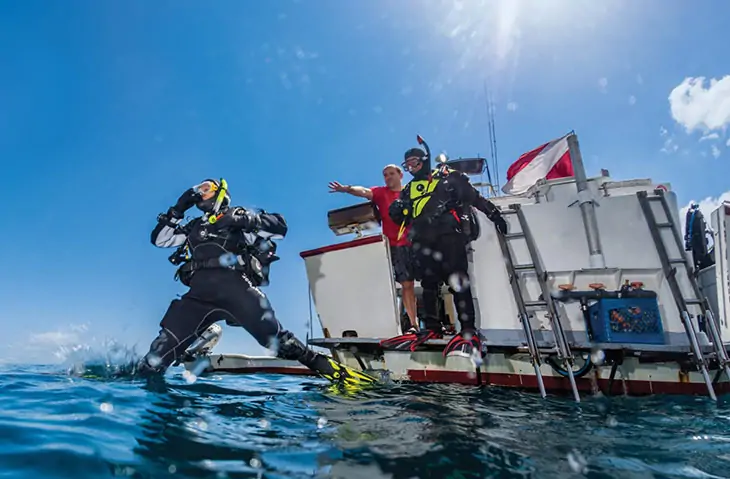
The diving entry/exit areas are those areas designated for you to enter and exit the water. On many boats, you enter and exit the same place – typically the stern – but with others, you enter and exit different areas. Large dive boats on the west coast of the United States, for example, commonly have divers enter from the sides and exit up the stern.
QUIZ
You need to be registered and logged in to take this quiz. Log in
{Module Title}
Copyright © Larry Wedgewood Scuba · All Rights Reserved